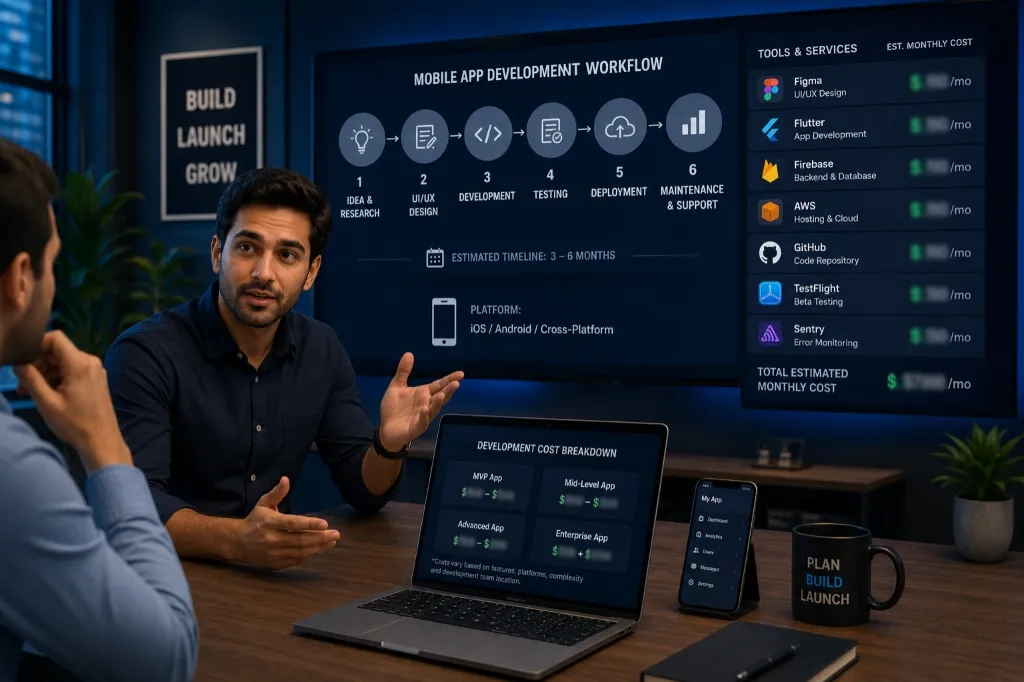
One of the most common questions businesses ask before starting digital product development is:
The short answer is: It depends on the complexity, features, technology stack, integrations, scalability requirements, and overall business goals.
The longer answer is where humanity discovers that “simple app idea” often secretly means: “Build me Uber, Instagram, Netflix, AI automation, banking systems, and teleportation in three weeks.”
Modern mobile app development involves far more than just designing screens. Businesses today require:
- scalable infrastructure
- strong UI/UX
- performance optimization
- secure payment systems
- backend architecture
- AI integrations
- cross-platform compatibility
- analytics systems
- ongoing maintenance
In this guide, we’ll explain:
- what affects mobile app pricing
- how businesses budget app development
- differences between iOS and Android costs
- startup app pricing expectations
- hidden app development expenses
- how businesses reduce development costs strategically
What Affects Mobile App Development Cost?
Several factors influence app development pricing.
The largest cost drivers usually include:
- app complexity
- feature requirements
- design quality
- integrations
- platform selection
- backend systems
- AI functionality
- scalability requirements
The more advanced the functionality becomes, the more development time and infrastructure are required.
How Much Does a Basic Mobile App Cost?
A basic mobile app usually includes:
- user authentication
- simple dashboards
- forms
- notifications
- lightweight backend systems
- basic UI design
Basic business apps often range from:
- MVP startup applications
- appointment booking systems
- service-based apps
- customer portals
- lightweight internal business tools
These projects typically cost significantly less than enterprise-level applications because they require fewer integrations and less infrastructure complexity.
What Makes Mobile Apps More Expensive?
Several features dramatically increase development costs.
Examples include:
- real-time chat systems
- payment gateways
- AI integrations
- GPS tracking
- live video streaming
- custom dashboards
- large-scale databases
- advanced automation systems
- marketplace functionality
- complex admin panels
For example: integrating Stripe payments, OpenAI-powered AI systems, Firebase authentication, or AWS cloud infrastructure increases both development complexity and operational scalability.
Businesses often underestimate how much backend infrastructure powers modern apps behind the scenes.
Users see buttons. Developers see: servers, APIs, databases, authentication layers, cloud architecture, analytics pipelines, caching systems, and existential despair.
How Much Does iOS App Development Cost?
iOS app development usually involves:
- Swift development
- Apple ecosystem optimization
- App Store compliance
- iPhone/iPad responsiveness
- performance optimization
iOS applications are commonly chosen by businesses targeting:
- premium customer segments
- North American markets
- subscription-based products
- high-engagement user bases
Costs depend heavily on app complexity, custom features, backend requirements, and scalability goals.
How Much Does Android App Development Cost?
Android app development often requires:
- broader device optimization
- multiple screen compatibility
- Kotlin development
- performance testing across devices
Android development can become more complex because of device fragmentation, varying hardware standards, and multiple Android versions.
Businesses targeting wider international audiences often prioritize Android development.
What Is Cross-Platform App Development?
Cross-platform frameworks allow businesses to build one application for both iOS and Android simultaneously.
Popular frameworks include:
- React Native
- Flutter
These technologies help reduce development time, maintenance complexity, and operational costs.
React Native is heavily used for scalable startup applications, while Flutter is popular for visually rich UI systems and rapid deployment.
Cross-platform development is often one of the most cost-efficient approaches for startups and growing businesses.
How Much Does UI/UX Design Affect App Pricing?
Strong UI/UX design significantly impacts mobile app success.
Businesses often underestimate how important usability, onboarding flow, visual clarity, navigation systems, and interaction design are for conversions and retention.
Professional UI/UX design using tools like Figma helps:
- improve engagement
- reduce user frustration
- increase retention
- strengthen customer trust
Poor design creates expensive problems later.
Users uninstall apps very quickly when experiences feel confusing or slow. Human patience online now lasts roughly three seconds before people emotionally relocate to another app.
What Backend Systems Increase App Costs?
Modern mobile apps require backend infrastructure to manage:
- users
- authentication
- payments
- databases
- automation
- notifications
- analytics
Common backend technologies include:
- Node.js
- Firebase
- AWS
- cloud databases
- API integrations
Apps with large-scale user systems or AI automation features require stronger backend scalability and security infrastructure.
Can AI Increase Mobile App Development Costs?
Yes.
AI-powered mobile apps usually require:
- OpenAI integrations
- workflow automation systems
- recommendation engines
- AI chat systems
- machine learning infrastructure
- advanced data processing
AI functionality increases development complexity, infrastructure requirements, API usage costs, and testing requirements.
However, AI features can also create major competitive advantages and operational efficiency.
What Hidden Costs Exist in Mobile App Development?
Businesses often forget ongoing operational expenses such as:
- hosting infrastructure
- cloud services
- app maintenance
- security updates
- analytics tools
- API subscriptions
- scaling infrastructure
- App Store fees
- ongoing optimization
Mobile apps are long-term digital products, not one-time design projects.
Maintenance and optimization are critical for security, performance, compatibility, and customer retention.
Can Small Businesses Afford Mobile App Development?
Yes.
Many businesses start with:
- MVP applications
- phased feature rollouts
- lightweight cross-platform apps
- automation-focused business tools
The smartest strategy is usually: build the core business functionality first, then scale features gradually based on customer feedback and business growth.
This reduces unnecessary development costs while improving product-market alignment.
How Businesses Reduce App Development Costs
Businesses commonly reduce costs through:
- phased development
- MVP strategy
- cross-platform frameworks
- reusable backend systems
- automation tools
- focused feature prioritization
The goal is not building the biggest app immediately. The goal is building the smartest scalable version first.
Why Mobile Apps Require Strategic Planning
Successful app development requires product strategy, UX planning, infrastructure design, scalability architecture, and customer experience optimization.
Without planning, businesses often:
- overspend
- overbuild
- delay launches
- create unstable systems
- struggle with adoption
Strong planning dramatically improves development efficiency and long-term profitability.
Final Thoughts
Mobile app development costs vary significantly depending on functionality, integrations, scalability, platform selection, design requirements, AI systems, and infrastructure complexity.
Technologies like React Native, Flutter, Swift, Kotlin, Firebase, AWS, Stripe, OpenAI, Figma, and Node.js have made mobile app development more scalable and accessible than ever before.
Businesses that approach development strategically often:
- reduce unnecessary costs
- launch faster
- improve scalability
- increase customer engagement
- create stronger digital products
At AZ Konnect, we help businesses design and develop scalable mobile applications focused on performance, growth, automation, and long-term business success.