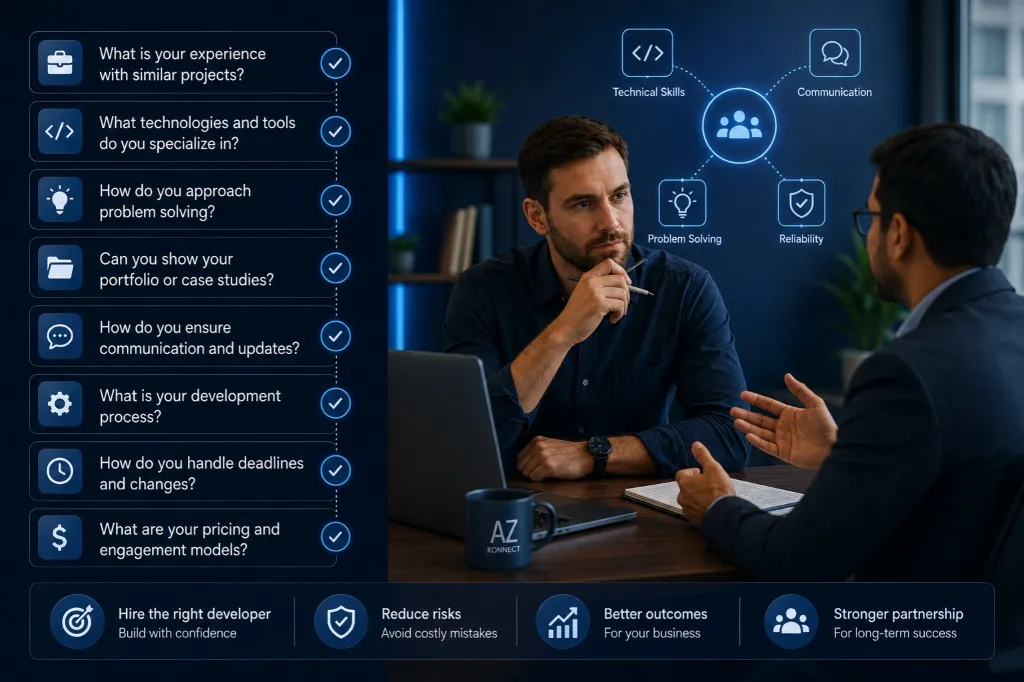
Hiring the wrong app developer can turn a promising business idea into a slow-moving technical disaster wrapped in missed deadlines and invoices labeled “final_v2_REAL_FINAL.”
Most businesses are not technical enough to fully evaluate developers during early conversations.
As a result, many companies end up hiring developers based on:
- low pricing
- impressive buzzwords
- vague promises
- flashy portfolios
- confidence levels usually reserved for people trying to sell crypto at 3 AM
The problem is: great app development requires much more than coding ability.
Businesses need development partners who understand:
- scalability
- UI/UX
- backend systems
- cloud infrastructure
- customer experience
- automation
- long-term product growth
Before hiring an app developer or app development company, businesses should ask strategic questions that reveal:
- technical capability
- communication quality
- project structure
- scalability planning
- long-term reliability
In this guide, we’ll explain:
- what questions businesses should ask developers
- how to evaluate technical expertise
- common hiring mistakes
- what technologies matter
- how to identify reliable development partners
Why Businesses Need to Vet App Developers Carefully
Modern mobile apps are complex systems involving:
- frontend development
- backend infrastructure
- APIs
- databases
- cloud systems
- security
- automation
- AI integrations
- analytics
- long-term maintenance
A weak development team can create:
- unstable applications
- scaling problems
- security risks
- slow performance
- expensive rebuilds later
Careful vetting helps businesses avoid costly technical mistakes before development begins.
What Questions Should I Ask Before Hiring an App Developer?
Several questions help businesses evaluate whether developers are truly qualified.
1. What Similar Apps Have You Built Before?
This is one of the most important questions.
Businesses should ask developers to show:
- real portfolio projects
- case studies
- live applications
- scalable systems
- apps similar to the desired product
Strong developers should explain:
- technical challenges
- scalability decisions
- UX strategy
- infrastructure planning
Portfolio quality matters far more than generic claims like:
Humanity has heard this sentence moments before countless digital catastrophes.
2. What Technologies Do You Recommend for My Project?
Qualified developers should explain:
- why specific technologies are appropriate
- scalability tradeoffs
- performance considerations
- future maintenance implications
Modern app development commonly uses:
- React Native
- Flutter
- Swift
- Kotlin
- Firebase
- AWS
- OpenAI integrations
Strong developers explain technology decisions clearly instead of hiding behind technical jargon.
Why React Native and Flutter Matter
React Native and Flutter are commonly used because they support:
- cross-platform development
- faster deployment
- scalable mobile systems
- lower operational costs
Businesses should ask:
- Why are you recommending React Native or Flutter?
- Should my app be native or cross-platform?
- What scalability limitations exist?
3. How Will You Handle Backend Infrastructure?
Most businesses focus only on app screens.
But backend infrastructure powers:
- databases
- authentication
- APIs
- notifications
- payments
- analytics
- cloud scalability
Businesses should ask:
- Will you use Firebase or AWS?
- How will user data be managed?
- How will the app scale as users grow?
- How is security handled?
Strong backend planning is critical for long-term performance.
4. How Do You Handle App Scalability?
Many apps work fine with:
- 50 users
- 500 users
Then collapse emotionally and technically once growth begins.
Businesses should ask developers:
- How will this app scale?
- What happens if traffic increases rapidly?
- How is infrastructure designed for growth?
- How are performance bottlenecks handled?
Scalability planning separates experienced developers from inexperienced ones.
5. How Do You Manage UI/UX Design?
Strong apps require excellent user experience.
Businesses should ask:
- Do you provide UI/UX design?
- Will wireframes be created first?
- What tools do you use?
- How do you optimize mobile usability?
Professional teams commonly use:
- Figma
- UX testing systems
- user flow mapping
- mobile interaction design
Poor UX destroys retention even if the backend is technically strong.
6. How Will Communication and Project Management Work?
Communication failures destroy many development projects.
Businesses should ask:
- How often will updates happen?
- Who manages the project?
- What project management tools are used?
- How are milestones tracked?
Strong teams commonly use:
- Jira
- Slack
- GitHub
- sprint planning systems
- structured reporting
Reliable communication is just as important as coding ability.
7. Who Actually Builds the App?
Some agencies outsource projects without clearly explaining it.
Businesses should ask:
- Is development in-house?
- Will freelancers be involved?
- Who handles backend systems?
- Who handles testing?
- Who manages deployment?
Transparency matters heavily in long-term development relationships.
8. How Do You Handle Testing and QA?
Apps require extensive testing across:
- devices
- operating systems
- screen sizes
- network conditions
Businesses should ask:
- How is QA testing handled?
- How are bugs tracked?
- What happens after launch?
- How are crashes monitored?
Strong development teams prioritize stability and testing early.
9. How Do You Handle AI Integrations?
Many modern businesses now require:
- AI assistants
- automation systems
- OpenAI integrations
- recommendation engines
- AI chat functionality
Businesses should ask:
- Have you integrated OpenAI APIs before?
- How do AI systems affect scalability?
- What are the infrastructure requirements?
AI-powered apps require additional architectural planning.
10. What Happens After Launch?
Many businesses forget that apps require:
- maintenance
- updates
- optimization
- scaling
- security patches
Businesses should ask:
- Do you provide ongoing support?
- How are updates handled?
- What maintenance costs exist?
- How are future features managed?
Apps are long-term products, not one-time projects.
How Do Businesses Evaluate Freelancers vs Agencies?
Businesses commonly hire developers through:
- Upwork
- Clutch
- agencies
- referrals
Freelancers Often Work Best For:
- MVPs
- lightweight apps
- short-term projects
Agencies Usually Work Better For:
- scalable platforms
- enterprise systems
- AI products
- long-term digital infrastructure
Businesses should evaluate:
- communication
- structure
- scalability experience
- support systems
not just pricing.
What Warning Signs Should Businesses Watch For?
Be cautious if developers:
- promise unrealistic timelines
- avoid technical explanations
- provide vague pricing
- lack real portfolio examples
- ignore scalability discussions
- communicate poorly
Reliable developers usually:
- ask strategic questions
- explain tradeoffs clearly
- discuss infrastructure early
- focus on long-term product success
Why Technical Strategy Matters More Than Cheap Pricing
Cheap development often creates:
- technical debt
- rebuild costs
- unstable systems
- poor scalability
Strong technical planning saves businesses enormous costs later.
The cheapest option is rarely the cheapest outcome. Humanity keeps conducting this experiment anyway with almost scientific dedication.
Final Thoughts
Hiring the right app developer requires more than reviewing pricing or flashy portfolios.
Businesses should evaluate:
- scalability planning
- communication
- technical expertise
- UI/UX understanding
- backend infrastructure
- long-term support
Technologies like:
- React Native
- Flutter
- Swift
- Kotlin
- Firebase
- AWS
- OpenAI
- GitHub
- Figma
- Jira
play major roles in modern mobile app development.
Businesses that ask the right questions early usually:
- avoid technical disasters
- reduce long-term costs
- improve scalability
- launch better products
- create stronger customer experiences
At AZ Konnect, we help businesses build scalable mobile apps, AI systems, and digital infrastructure designed for long-term growth and operational performance.