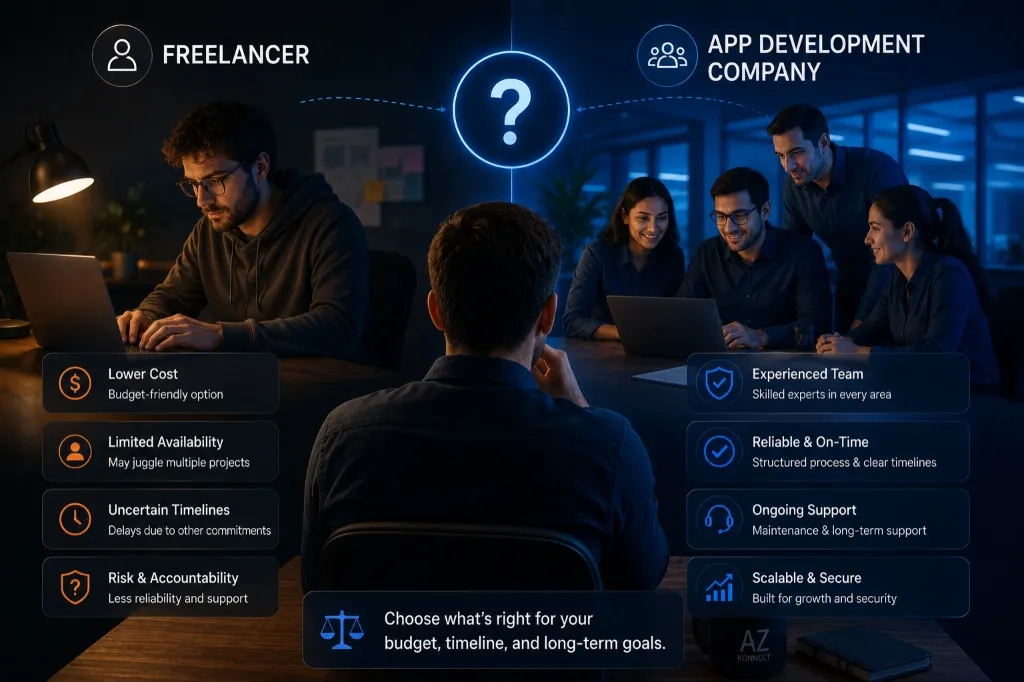
One of the biggest decisions businesses face before starting a mobile app project is:
It sounds simple at first.
Until you realize your “small app idea” suddenly involves:
- UI/UX design
- backend systems
- APIs
- cloud infrastructure
- AI integrations
- mobile optimization
- security
- testing
- scalability planning
- ongoing maintenance
At that point, choosing the wrong development partner can become painfully expensive.
Businesses often ask:
- Are freelancers cheaper than agencies?
- Which option is better for startups?
- What are the risks of hiring freelancers?
- Do agencies provide better quality?
- Which option scales better long-term?
The truth is: both freelancers and app development companies have advantages depending on:
- project complexity
- budget
- timeline
- scalability goals
- long-term business needs
In this guide, we’ll compare:
- freelancers vs agencies
- costs
- scalability
- communication
- project management
- long-term reliability
- which option works best for different business types
What Is a Freelance App Developer?
Freelance app developers are independent contractors who typically work on projects individually or with small teams.
Businesses commonly hire freelancers through platforms like:
- Upwork
- Fiverr
- Toptal
Freelancers often specialize in:
- React Native
- Flutter
- Swift
- Kotlin
- UI/UX design
- backend development
- AI integrations
- API development
Freelancers are usually best suited for:
- smaller projects
- MVP applications
- lightweight apps
- short-term development tasks
What Is an App Development Company?
An app development company or mobile app development agency usually provides:
- developers
- designers
- project managers
- QA testing
- backend engineers
- UI/UX specialists
- DevOps support
Agencies handle complete development workflows from:
- planning
- wireframing
- development
- testing
- deployment
- maintenance
Businesses commonly hire agencies for:
- startup products
- SaaS platforms
- enterprise systems
- AI applications
- scalable mobile apps
- long-term digital infrastructure
Are Freelancers Cheaper Than App Development Agencies?
Usually, yes.
Freelancers often charge lower upfront costs because:
- they operate independently
- overhead costs are lower
- project structures are smaller
This makes freelancers attractive for:
- startups
- early-stage MVPs
- smaller business projects
However, lower pricing sometimes comes with tradeoffs including:
- limited scalability
- slower delivery
- communication gaps
- weaker testing systems
- limited long-term support
Cheap development often becomes expensive later when businesses must rebuild unstable systems.
Humanity keeps repeating this cycle with remarkable determination.
What Are the Benefits of Hiring Freelance Developers?
Freelancers can be excellent for certain projects.
1. Lower Initial Cost
Freelancers usually cost less than agencies for smaller projects.
This makes them attractive for:
- startups
- prototypes
- MVP launches
- lightweight mobile apps
2. Faster Hiring Process
Platforms like Upwork and Fiverr allow businesses to hire developers quickly.
Businesses can:
- review portfolios
- compare pricing
- evaluate reviews
- hire rapidly
3. Specialized Technical Skills
Some freelancers specialize deeply in:
- React Native
- Flutter
- Swift
- Kotlin
- Firebase
- OpenAI integrations
This can work well for highly specific technical tasks.
What Are the Risks of Hiring Freelancers?
Freelancers also introduce several operational risks.
1. Limited Scalability
One developer usually cannot handle:
- frontend
- backend
- UI/UX
- cloud systems
- QA testing
- infrastructure scaling
alone at enterprise quality.
As projects grow, limitations become more obvious.
2. Project Continuity Risks
Freelancers may:
- become unavailable
- leave projects midway
- disappear during deadlines
- struggle with large workloads
Businesses relying heavily on one individual create operational risk.
3. Limited Project Management
Freelancers often focus only on coding.
Businesses may still need:
- project management
- testing
- UX planning
- deployment coordination
- infrastructure planning
Without structure, projects can become chaotic quickly.
What Are the Benefits of Hiring an App Development Company?
Agencies are usually better suited for scalable and long-term projects.
1. Full Development Teams
Agencies provide:
- UI/UX designers
- frontend developers
- backend engineers
- QA testers
- project managers
- infrastructure specialists
This creates stronger development structure and quality control.
2. Better Scalability
Agencies are typically better equipped for:
- enterprise apps
- AI systems
- SaaS products
- automation platforms
- scalable cloud infrastructure
They can scale development resources as projects grow.
3. Structured Project Management
Agencies usually provide:
- timelines
- sprint planning
- QA testing
- documentation
- communication systems
- deployment processes
This improves operational reliability significantly.
4. Long-Term Support
Most agencies provide:
- maintenance
- updates
- optimization
- scaling support
- infrastructure monitoring
Long-term technical support is critical for modern mobile applications.
Which Option Is Better for Startups?
The answer depends on:
- budget
- complexity
- growth goals
Freelancers Are Often Better For:
- lightweight MVPs
- simple prototypes
- early-stage testing
- limited budgets
Agencies Are Usually Better For:
- scalable startup products
- funded startups
- SaaS platforms
- AI applications
- long-term business infrastructure
Startups planning aggressive growth often benefit from structured agency support early.
What Technologies Should Good Developers Know?
Modern app development commonly involves:
- React Native
- Flutter
- Swift
- Kotlin
- Firebase
- AWS
- OpenAI
- GitHub
- Figma
Businesses should hire developers who understand:
- scalability
- backend architecture
- cloud systems
- UI/UX
- mobile optimization
not just coding syntax.
Why React Native and Flutter Are Popular
React Native and Flutter are heavily used because they support:
- cross-platform development
- faster deployment
- lower development costs
- scalable mobile systems
These frameworks allow businesses to launch apps on:
- iOS
- Android
from one codebase.
Why Backend Infrastructure Matters
Apps require far more than frontend screens.
Modern mobile apps often depend on:
- Firebase authentication
- AWS cloud infrastructure
- APIs
- payment systems
- analytics
- databases
- AI integrations
Strong backend planning dramatically affects:
- scalability
- performance
- security
- operational stability
How Businesses Choose the Right Development Partner
Businesses should evaluate:
- portfolio quality
- communication
- scalability experience
- technical stack
- project structure
- UX understanding
- long-term support capabilities
Strong development partners ask strategic questions instead of immediately promising unrealistic timelines.
If someone says they can build “Uber plus AI plus blockchain plus social network” in two weeks for the price of a pizza, perhaps reconsider your life choices carefully.
Should Businesses Outsource App Development?
Outsourcing app development is now extremely common.
Businesses outsource because it:
- reduces hiring complexity
- improves flexibility
- lowers infrastructure costs
- provides specialized expertise
- speeds up development timelines
However, choosing the right partner remains critical.
Final Thoughts
Choosing between a freelancer and an app development company depends heavily on:
- budget
- complexity
- scalability
- long-term goals
Freelancers can work well for:
- lightweight projects
- MVP builds
- short-term development
Agencies are usually stronger for:
- scalable applications
- AI systems
- enterprise infrastructure
- long-term digital growth
Platforms like:
- Upwork
- Fiverr
- Toptal
- Clutch
help businesses discover developers and agencies globally.
Technologies like:
- React Native
- Flutter
- Swift
- Kotlin
- Firebase
- AWS
- OpenAI
- GitHub
- Figma
continue shaping modern mobile app development.
At AZ Konnect, we help businesses design, develop, and scale high-performing mobile applications and digital systems built for long-term growth.